
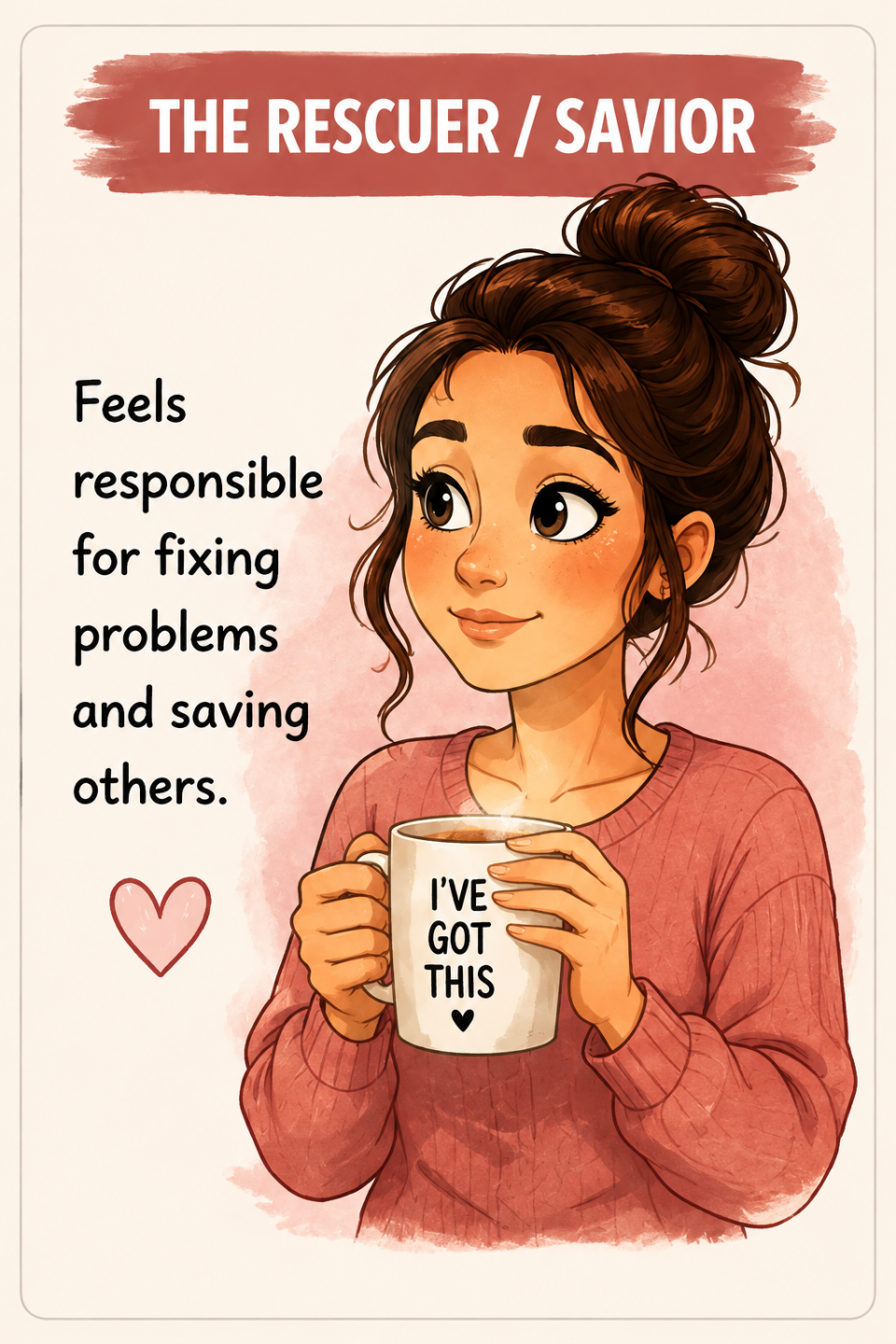
THE RESCUER / SAVIOR
“If I can fix it, maybe everything will finally be okay.”
You notice when something is wrong—often before anyone else does. When someone you love is struggling, making unhealthy choices, hurting, or simply not seeing what you can so clearly see, your mind naturally begins searching for answers:
What’s really going on? What could help? What does he need to understand? What can I do?
You may call it helping, loving, supporting, encouraging, or even discerning. And much of it comes from a genuinely beautiful place:
You care deeply. But somewhere along the way, caring may have become carrying.

Core Need: Safety and connection through being helpful and needed

Core Fear: If I don't help, someone I love may fall apart—and I may have to helplessly watch it happen.

Core Belief: “If I can figure out what's wrong and help fix it, I can make things okay.”

Protective Strategy: Fix. Advise. Research. Explain. Intervene. Remind. Monitor. Persuade.

What Love Can Become: Taking responsibility for another person's choices, healing, growth, or consequences.
HOW DID I GET THE RESCUER/SAVIOR BORROWED IDENTITY?
You didn't wake up one day and decide to carry everyone.
The Rescuer often develops in a family system where something needed fixing.
Maybe there was conflict, addiction, emotional instability, illness, unpredictability, an overwhelmed parent, struggling siblings, or simply problems that never seemed to get resolved.
- Perhaps you became the one who noticed.
- The one who helped.
- The one who mediated.
- The one who figured things out.
- The one who tried to make everyone okay.
And somewhere along the way, your younger heart may have learned:
“Things feel safer when I'm helping make them better.”
Being helpful may have brought connection, significance, appreciation, or a sense of control in circumstances where you otherwise felt powerless.
The strategy made sense then.
But what once helped you navigate your family system may now be quietly running your adult relationships.
WHEN HELPING BECOMES AN IDENTITY
They exchanged the truth about God for a lie, and worshiped and served created things rather than the Creator—who is forever praised. Amen. Romans 1:25
God created you with the beautiful capacity to love, serve, encourage, support, and care for others. But the enemy of your soul loves to distort what God created for good.
A subtle shift can happen:
- “I love helping people.” becomes...
- “I should help when I see a problem.”
which becomes...
- “If I don't help, something bad might happen.”
and eventually...
- “It's my responsibility to make this better.”
What began as compassion becomes responsibility. What began as support becomes control. What began as love becomes carrying something God never asked you to carry. And eventually, being the helper can begin feeling like who you are.

HOW THE RESCUER MAY SHOW UP IN YOUR MARRIAGE
Marriage can activate the Rescuer powerfully because your husband's choices affect you.
So when something isn't healthy, of course you notice.
But instead of simply recognizing the problem, you may find yourself becoming consumed with solving it.
You might:
- Spend enormous amounts of time analyzing what your husband needs to heal, understand, change, or work on.
- Research books, podcasts, counselors, Scripture, attachment styles, trauma, communication tools, or resources that might finally help him understand.
- Explain the same concern multiple ways hoping this time he'll get it.
- Remind, encourage, teach, prompt, coach, or correct.
- Try to prevent choices you believe will hurt him, you, or your family.
- Cushion consequences or compensate for things he isn't taking responsibility for.
- Monitor his moods, behaviors, progress, or willingness to change.
- Feel enormous frustration when you can clearly see a solution he refuses to pursue.
- Believe that if he would just heal, understand, repent, change, or get help, you could finally relax.
And slowly, something happens.
Your husband's healing becomes your full-time emotional job.
Your body may be sitting on the couch while your mind is working overtime trying to figure out another human being.
And while you're becoming an expert on him, you can slowly lose connection with you.
WHAT IS THE RESCUER REALLY AFRAID OF?
Underneath all that helping is often something much more vulnerable:
Helplessness.
Watching someone you love struggle and realizing:
I cannot make them change.
I cannot make them see.
I cannot make them heal.
I cannot make them choose differently.
I cannot control what happens next.
That can feel terrifying to the Rescuer.
So instead of experiencing the discomfort of powerlessness, you move into action.
You fix.
You explain.
You research.
You intervene.
You try again.
Because doing something feels safer than accepting: “This isn't mine to control.”
WHAT THIS BORROWED IDENTITY CAN COST YOU
The Rescuer can look incredibly loving from the outside while leaving the woman underneath it exhausted.
You may experience:
Anxiety. Resentment. Hypervigilance. Disappointment. Emotional exhaustion. Difficulty resting. Frustration when others won't change. Confusion about where your responsibility ends and theirs begins.
But perhaps one of the greatest costs is this:
You can become so consumed with another person's healing that you slowly abandon your own.
Your attention stays outward:
What's wrong with him?
Why does he do this?
How do I get him to understand?
What does he need to work on?
While God may gently be inviting you back inward:
“Daughter, what is happening inside of YOU?”