
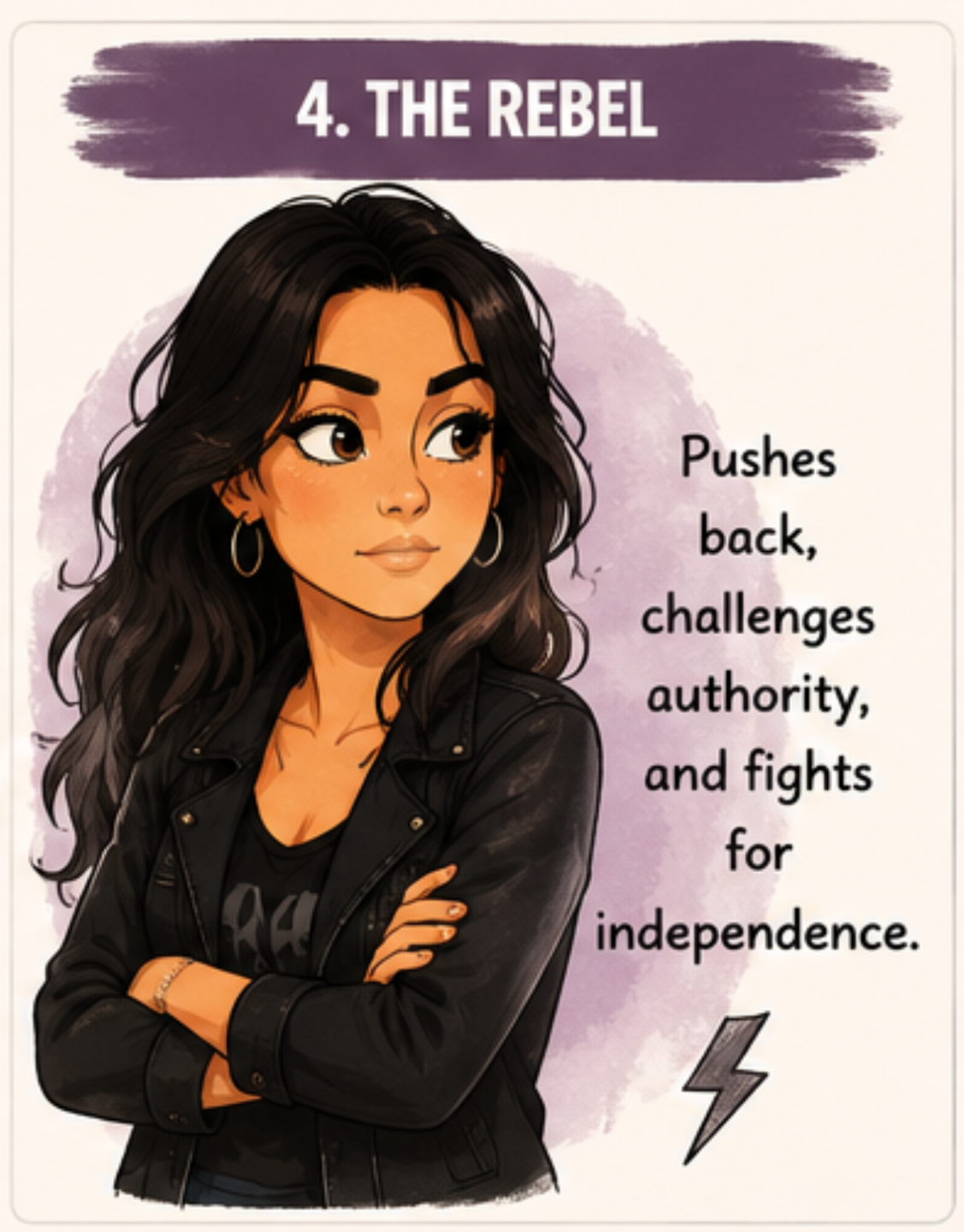
THE REBEL / SCAPEGOAT
“If I stay in control of myself and my choices, I can stay safe.”
You notice pressure quickly. Control. Manipulation. Coercion. Unfairness. Someone trying to tell you what you should think, feel, or do. Your system may react before you've even had time to think:
No. You're not going to control me.
Much of it comes from something deeply understandable:
You learned to protect yourself.
But somewhere along the way, protection may have become constant resistance.

Core Need: Internal safety
Core Fear: Powerlessness, being trapped, controlled, coerced, or at someone else's mercy

Core Belief: “I have to stay in control of myself and my choices to be safe.”
Protective Strategy: Fight. Resist. Push back. Refuse. Challenge. Take control. Scan for threat.

What Love Can Become: A place where influence, dependence, expectations, or vulnerability can feel dangerously close to control.
HOW DID I BECOME THE REBEL?
You didn't wake up one day and decide to fight everything.
The Rebel often develops in a family system where power wasn't experienced as safe.
- Maybe there was control, manipulation, domination, inconsistency, unfairness, chaos, hypocrisy, or dysfunction no one was willing to acknowledge.
- Perhaps you became the one who pushed back.
- The one who refused.
- The one who exposed what everyone else pretended wasn't happening.
- The one eventually labeled the problem.
And somewhere along the way, your younger heart may have learned:
“If I don't protect myself, someone else will have power over me.”
The strategy made sense then.
But a nervous system trained to look for control may continue finding threats long after the original system is gone.
WHEN STRENGTH BECOMES AN IDENTITY
They exchanged the truth about God for a lie, and worshiped and served created things rather than the Creator—who is forever praised. Amen. Romans 1: 25
God created you with the capacity for strength, courage, discernment, agency, conviction, and healthy autonomy.
But the enemy of your soul loves to distort what God created for good.
- “I can make my own choices.” becomes...
- “I need to protect my choices.” which becomes...
- “Nobody gets to tell me what to do.” and eventually...
- “I am only safe when I am the one in control of myself and my circumstances.”
What began as strength becomes resistance.
What began as discernment becomes hypervigilance.
What began as autonomy becomes an inability to safely receive influence.
And eventually, fighting can begin feeling like safety.
HOW THE REBEL MAY SHOW UP IN YOUR MARRIAGE
Marriage naturally involves influence, compromise, requests, expectations, boundaries, and dependence—which can activate the Rebel's threat system.
You might:
- Immediately push back when you feel told what to do.
- Hear a request as a demand.
- Become highly alert to manipulation, pressure, or hidden motives.
- Feel trapped when expectations are placed on you.
- Resist something you might otherwise choose simply because you feel pressured.
- Become intensely defensive when corrected.
- Escalate quickly when you feel controlled.
- Need to regain control before you can calm down.
- Interpret your husband's strong emotions as something you must protect yourself against.
- Feel safest when you know no one has the power to make you do something you don't want to do.
And sometimes:
You may be fighting against control that is happening—and sometimes against control your nervous system expects to happen.
WHAT IS THE REBEL REALLY AFRAID OF?
Underneath the fight is often:
Powerlessness.
Being trapped.
Being coerced.
Being dependent on someone unsafe.
Being unable to escape.
Being at another person's mercy.
So your system stays ready.
Scanning.
Watching.
Preparing.
Because resistance can feel safer than discovering whether it's actually safe to soften.
“If I don't stay in control, who will protect me?”
WHAT THIS BORROWED IDENTITY CAN COST YOU
The Rebel can look incredibly strong while the woman underneath is constantly braced for danger.
You may experience:
Hypervigilance. Anger. Defensiveness. Exhaustion. Difficulty trusting. Difficulty receiving feedback. Conflict escalation. Isolation. Difficulty compromising without feeling controlled.
Perhaps one of the deepest costs is:
You can become so committed to never being controlled that your fear of control begins controlling you.